The Entry Into Force of the BBNJ Agreement
On 17 January 2026, the "Agreement under the United Nations Convention on the Law of the Sea on the Conservation and Sustainable Use of Marine Biological Diversity of Areas beyond National Jurisdiction" (BBNJ Agreement or Agreement) entered into force. The Agreement was adopted on 19 June 2023 after almost twenty years of negotiations. It has 145 signatories and currently numbers 85 parties.
The Agreement is the first global framework treaty dedicated to safeguarding marine biodiversity in areas beyond national jurisdiction. It is the third agreement implementing the 1982 U.N. Convention on the Law of the Sea (UNCLOS), the first two being the 1994 Part XI Implementation Agreement and the 1995 Fish Stock Agreement. As with the latter, a state need not be an UNCLOS party to join the BBNJ Agreement. The US is party only to the 1995 Fish Stock Agreement.
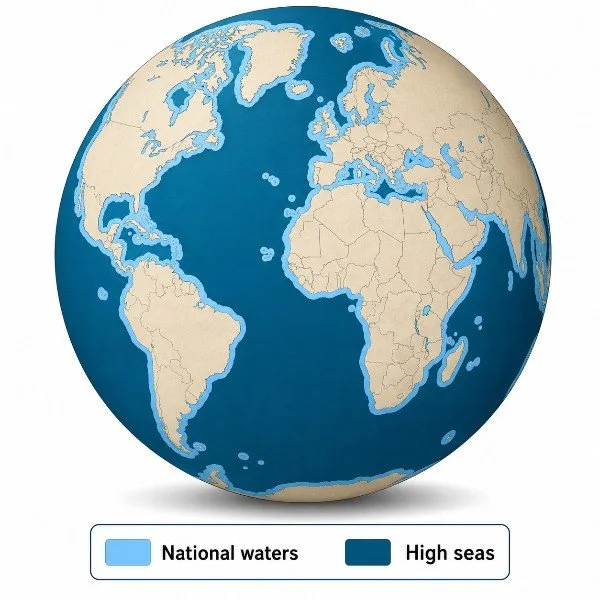
The objective of the BBNJ Agreement is "to ensure the conservation and sustainable use of marine biological diversity of areas beyond national jurisdiction…through effective implementation of the relevant provisions of the Convention [UNCLOS] and further international cooperation and coordination" (art. 2). "Areas beyond national jurisdiction" is defined as "the high seas and the Area" (art.1(2)). "Area" means "the seabed and ocean floor and subsoil thereof, beyond the limits of national jurisdiction." (art. 1(1)(1) UNCLOS). Practically, the Agreement covers activities outside of the Exclusive Economic Zone and Continental Shelf of coastal states.
The Agreement is sometimes referred to as "the High Seas Treaty." However, since it applies to both the high seas and the Area, this reference might misleadingly suggest that the Agreement applies only to the high seas water column.
The Agreement regulates in some depth four basic focus areas:
a) marine genetic resources,
b) area-based management tools, such as marine protected areas,
c) environmental impact assessments, and
d) capacity-building and technology transfer.
Additionally, it provides for a funding mechanism as well as institutional arrangements, including the establishment of a Conference of the Parties, a Scientific and Technical Body, a Secretariat, a Clearing-House Mechanism and other bodies.
Being an UNCLOS implementing treaty, it is to "be interpreted and applied in the context of and in a manner consistent with the Convention" (art. 5(1)), and "in a manner that does not undermine" and is coherent with other relevant legal instruments, frameworks and global, regional, subregional and sectoral bodies. (art. 5(2)).
The Agreement incorporates a number of general principles. These include the polluter-pays principle, the principle of common heritage of mankind, high seas and marine scientific research freedoms, the precautionary principle/approach, the ecosystem approach, ecosystem resilience including to the adverse effects of climate change and ocean acidification, the use of best available science and scientific information, equity, and other ones (art. 7).
Regarding ships, art. 4 of the Agreement specifically states that it does not apply to any warship – nor to any military aircraft or naval auxiliary. Also, except for Part II [on Marine Genetic Resources], it does not apply to government-owned or operated vessels or aircraft in governmental noncommercial use by a state party. However, the same article goes on to introduce what seems to be a due diligence obligation for parties to "ensure, by the adoption of appropriate measures not impairing the operations or operational capabilities of such vessels or aircraft owned or operated by it, that such vessels or aircraft act in a manner consistent, so far as is reasonable and practicable, with this Agreement."
Almost certainly, the maritime sector will be directly impacted as the Agreement starts being implemented. For instance, if shipping routes need to be redirected around newly established marine protected areas in the high seas, the time and costs of such voyages will inevitably increase. The Agreement is ambitious; nevertheless, its long-term success will largely depend on the political will of its parties and their commitment to implement it in a manner that will help achieve its object and purpose without imposing imbalanced burden to international shipping and other critical global sectors. The recent climate change advisory opinions by the International Court of Justice and the International Tribunal for the Law of the Sea will most likely inform the manner in which parties should interpret and apply the Agreement.